Wrapping and Gifting Math: Volume, Area, and Ribbon Length
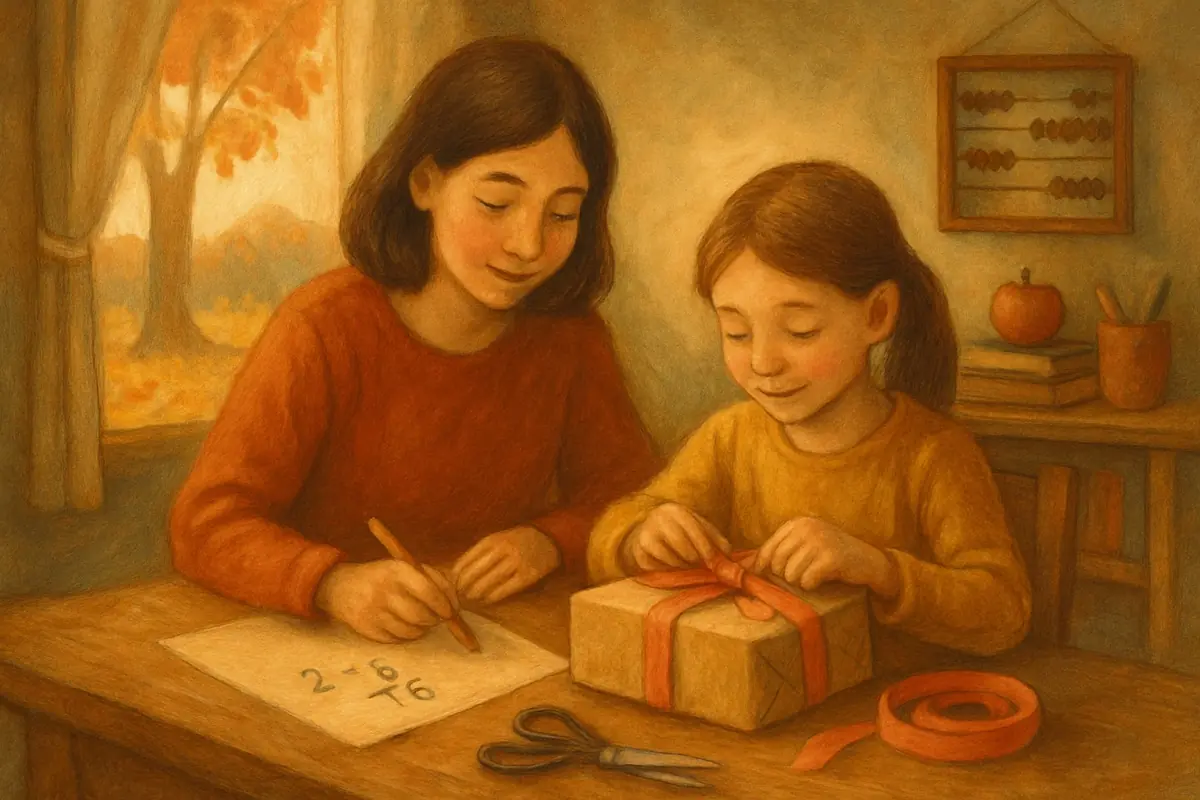
Picture a wrapping session where a parent tapes a lumpy corner, the paper tears, and someone runs out of ribbon halfway around the box. Nobody thinks of it as math. It's just the annoying part before the fun part. But wrapping a present is one of the cleanest measurement problems a kid will ever touch, and it's sitting right there on your floor.
Here's how to turn a wrapping session into a real gift wrapping math activity, without turning it into a worksheet. The trick is to let the box ask the questions.
Start with a wrong guess on purpose
Before anyone cuts anything, hand your kid a box and ask how much paper they think it needs. Not the right amount. Just a guess. Have them tear off what they think will work and set it down next to the box.
Then wrap it and compare the guess with the paper actually used. For an illustrative example, a child might estimate an 80-centimeter sheet length, then find that a 60-centimeter length works for that box and wrapping method. The estimate is 20 centimeters longer. Keep the width and overlap in the check too; sheet length alone does not tell you whether the whole box is covered. Try another box if the child wants another turn.
The paper problem is surface area, quietly
To wrap a rectangular box you cover six faces. That's surface area, whether or not you ever say the words. You don't need the formula for young kids. You need the idea that a box has a top and a bottom and four sides, and the paper has to reach all of them plus a little to overlap.
For an older kid, make it concrete with one box:
- Measure the length, width, and height in centimeters
- Figure the two big faces (length times width), then double it
- Do the same for the other two pairs of faces
- Add it all up, then add a strip for overlap
A shoebox that's 30 by 18 by 11 comes out to over 1,800 square centimeters of surface. Kids are shocked by how big that number is for a box they can hold in two hands. That surprise is worth more than the answer. It tells them their intuition about size and their intuition about area don't match yet, and now they're paying attention.
For the paper itself, there's a shortcut wrappers actually use. The sheet needs to be a little longer than twice the height plus the width, and wide enough to go around the box with a couple of centimeters to spare. Let your kid derive that by wrapping one box and looking at where the paper meets. They'll figure out the rule faster by doing it than by being told.
Ribbon length is addition you can see
Ribbon is the friendliest math on the table because it wraps all the way around and comes back to where it started. A kid can literally watch the length add up.
Wrap ribbon around the box one way, mark where it meets, then the other way, and add the two loops. Then throw in extra for the bow. Ask your kid to predict the total before you measure the ribbon flat, and check. A box that measures 40 centimeters around the short way and 60 the long way needs at least a meter just to circle both directions, before a single loop of bow. Kids consistently forget the bow eats ribbon, so let them run short once. Running short teaches the lesson that a warning never could.
If you've got a few gifts to do, this becomes a nice running total. How much ribbon for all five presents? Now you're adding a column of numbers with a reason to get it right, because the answer decides whether you have enough on the spool.
Volume shows up with the odd-shaped gifts
Rectangular boxes are the easy case. The learning gets richer the moment you hit a gift that isn't a neat box. A mug, a stuffed animal, a book that's much thinner than it is wide.
This is where volume and shape start to matter. Ask your kid why a soccer ball is so hard to wrap when a book is easy, even if they take up about the same room. The book is flat, so paper lies against it. The ball curves away in every direction, so the paper has to bunch. That's a real conversation about surface and shape, and it comes straight out of frustration with the wrapping.
For the boxes you do have, volume is a fun aside. Length times width times height tells you how much room is inside. Two boxes can hold wildly different amounts even when they look similar. Let your kid measure a tall skinny box and a short wide one, calculate both, and be surprised when the "smaller looking" one holds more. Feeling that surprise once does more for their number sense than a page of volume problems.
Keep it loose, keep it real
You don't have to hit all of this in one night. Pick the piece that fits the kid in front of you. A first grader can guess and check paper sizes and count boxes. A third grader can measure ribbon and add totals. A fifth grader can chase surface area and compare volumes. Same pile of presents, three different lessons.
A few things that keep it from turning into homework:
- Let them make the guesses and be wrong out loud. Wrong guesses are the engine.
- Don't correct the estimate before the check. The check does the correcting.
- Skip the formulas for the little ones. The hands-on version is the real thing.
- Stop while it's still fun. A tired kid learns nothing from one more box.
The reason this works is that the math has a point. The kid isn't finding the area because a worksheet said to. They're finding it because they're about to cut paper and don't want to waste it or run short. That's what real math feels like from the inside, a question you actually need answered. Kids can tell the difference between practice that matters and practice that's just there to fill time. Give them the kind that matters, even if it's wrapped around a present.
When the paper's cut and the last bow is on, you don't have to announce that you just did math. Your kid already knows. They measured, they guessed, they fixed their guess, and they got a present wrapped at the end of it. That's a good night's work by any measure.