Area vs. Perimeter: Understanding the Mix-Up
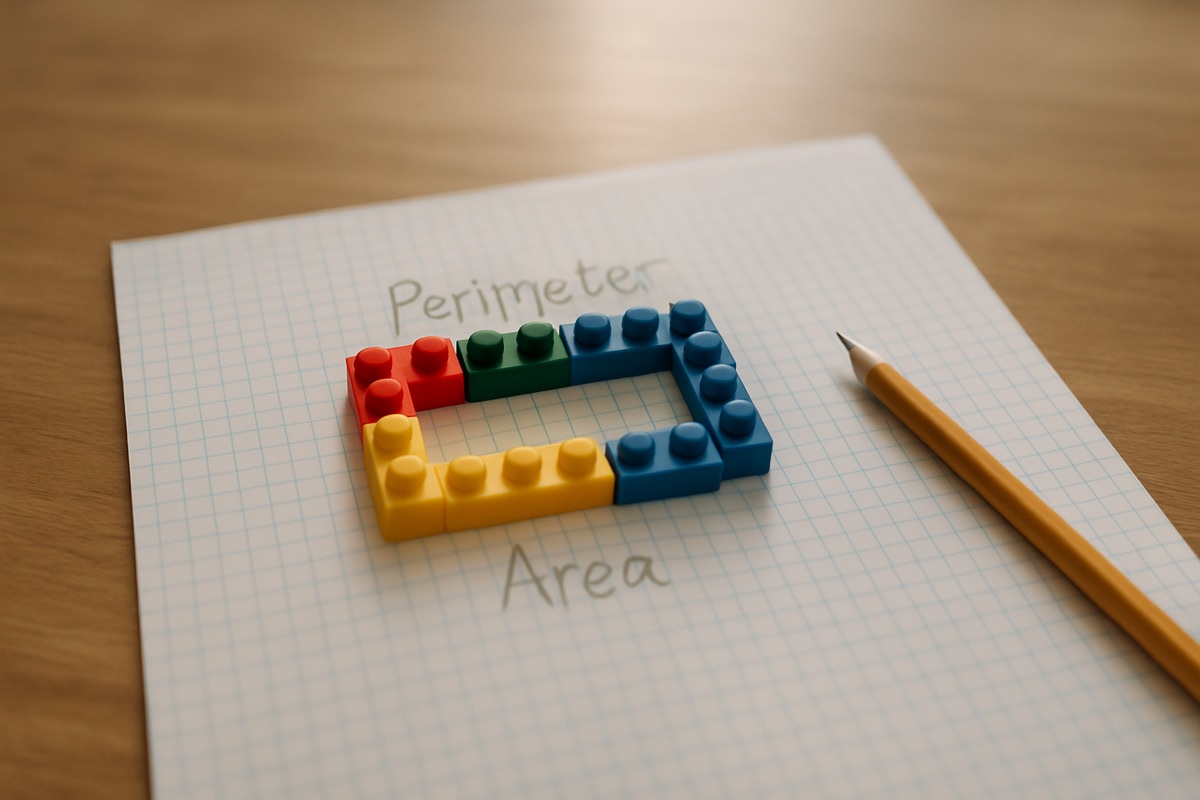
Consider an illustrative example: a child sees a rectangle 4 inches long and 3 inches wide, adds 4 + 3 + 4 + 3, and labels 14 inches as its area. The addition is correct, but it measures the boundary rather than the space inside. Separating what area and perimeter measure gives the child a way to check which calculation belongs to the question.
Before choosing a formula, show what each measurement describes.
Perimeter is the fence. Area is the grass.
Use this picture to distinguish the boundary from the space inside.
Perimeter is the distance around the edge. If you were walking a dog around the outside of a yard, the perimeter is how far you'd walk. Area is how much stuff fits inside. If you were laying down squares of sod to cover that yard, the area is how many squares you'd need.
One is a line you trace. The other is a space you fill. Both questions can give the same two numbers, a length and a width, so identify the requested measurement before choosing an operation.
The fence-and-grass picture offers a question to check before calculating: "Am I measuring the fence or the grass right now?"
Make them build it before they calculate it
Use one-inch square tiles or draw equal squares on grid paper to model both measurements on the same rectangle.
Try this sequence:
- Build a rectangle out of tiles, say 4 tiles across and 3 tiles down.
- Count every tile you used to fill it in. That's the area. Twelve tiles, twelve square inches.
- Now trace your finger around the whole outside edge, counting the tile-lengths as you go. That's the perimeter. Fourteen.
The tiles fill the space, while the traced edge marks its boundary. The two numbers are different because they measure different things.
Connect the completed rectangle to the formulas: length times width counts all the squares without counting them one by one, while adding the four side lengths counts the boundary. Use the model to explain each calculation.
Watch the units, because the units tell the truth
Units provide another check.
Perimeter is measured in plain units: inches, feet, centimeters. You're measuring a distance, a line, so the answer is a length.
Area is measured in square units: square inches, square feet. You're covering a surface, so you count little squares.
Write the units alongside each answer. If a child finds the area of a rug and writes "24 feet" instead of "24 square feet," check whether the answer describes a length or a surface. The word "square" identifies an area measurement. Use that distinction to review the calculation as well as its label.
Give the words a job in real rooms
Look for the same measurements in household tasks, so the examples are not limited to graph paper.
Examples to try:
- Framing a picture. The frame goes around the edge, so that's perimeter. The glass covers the whole photo, so that's area.
- Putting a border of stickers around the edge of a poster is perimeter. Coloring the whole poster in is area.
- Baseboard trim runs along the bottom of the walls, around the room. Perimeter. The carpet covers the floor. Area.
Name the measurement needed for the task: "We need to know the perimeter of your room to buy the right amount of trim." For carpet, ask how much floor space needs covering instead. Compare the two questions before reaching for a formula.
When it still gets swapped, slow down instead of drilling more
If a child keeps mixing the measurements up, pause extra calculations and identify what each problem asks to measure.
Before calculating, ask: "Are we measuring the fence or the grass here? Point to what we're finding." Then choose whether to trace the edge or cover the inside. If an answer looks wrong, review both the selected measurement and the arithmetic.
If the terms are still easy to mix up, return to one shape and label both measurements. Compare its boundary and inside, check the units, then try another example.